
Lee County Projected Versus Actual
A projected date is an administrative forecast. An actual release is a completed event supported by a release sheet, a dated KDOC Daily Releases entry, a supervision-begin record, or an executed court order. Kentucky Online Offender Lookup, or KOOL, uses several labels that must remain distinct: Projected Release Date, Expected Time To Serve, Minimum Expiration of Sentence Date, Parole Eligibility Date, and Maximum Expiration of Sentence Date.
Maximum expiration is the sentence endpoint before applicable reductions, subject to aggregation and legal rules. Minimum expiration, also described as a good-time release date, reflects credits recognized in sentence administration. Parole eligibility is only the point when Board consideration may begin. The Board can deny parole, defer review, or order a serve-out. None of these date fields guarantees the day or time someone will walk out.
A person held before trial at Three Forks Regional Jail has no sentence-based projected date. Bond, recognizance, dismissal, a judge’s order, or transfer controls that departure. A locally sentenced person may have a calculated end date, but Three Forks publishes no local good-time or weekend-release policy. Ask for the judgment and jail calculation instead of guessing.
Search Lee County Projected Release
The custody system determines the search. Lee Adjustment Center is a state-contract prison, so its prisoners belong in KOOL and KDOC records. Three Forks is the regional county jail, and its Current Inmates page is not a sentence calculator. A name disappearing from that list can mean community release, transfer, another agency hold, or a data change.
- Confirm whether the person is at Three Forks, Lee Adjustment Center, or another facility.
- For a state prisoner, search KOOL by name and then by DOC or PID number.
- Compare Projected Release, Minimum Expiration, Maximum Expiration, and Parole Eligibility fields without treating them as equivalents.
- For a Three Forks detainee, contact the jail at 606-464-2598 and ask for the existing release calculation or record.
- Obtain the signed judgment from the Lee Circuit Court Clerk when court terms control.
- After the expected date, verify the event through KDOC Daily Releases, VINE, the jail release sheet, or the receiving agency.
KOOL warns that newer data may not be finalized. A missing former-offender record also does not prove the person was never in KDOC. For information no longer shown online, request records from KDOC Offender Information Services, P.O. Box 2400, Frankfort, KY 40602-2400. The full Lee County released-inmate search covers local, state, court, and transfer paths.
KOOL Release Date Fields
KOOL’s advanced search uses the exact filters “Projected Release Date From” and “Projected Release Date To.” Details can display other date labels. Those fields serve different legal and administrative purposes, so copying only the earliest date can mislead. Use the label as written and note when the record was retrieved.
| KOOL field | What it means |
|---|---|
| Projected Release Date | A current administrative forecast that may change |
| Expected Time To Serve | An estimate tied to the sentence calculation |
| Minimum Expiration | The good-time release date based on credited time |
| Parole Eligibility | Earliest review point, not parole approval |
| Maximum Expiration | Sentence endpoint before applicable reductions |
The official KOOL FAQ explains update, photograph, and former-offender limits.
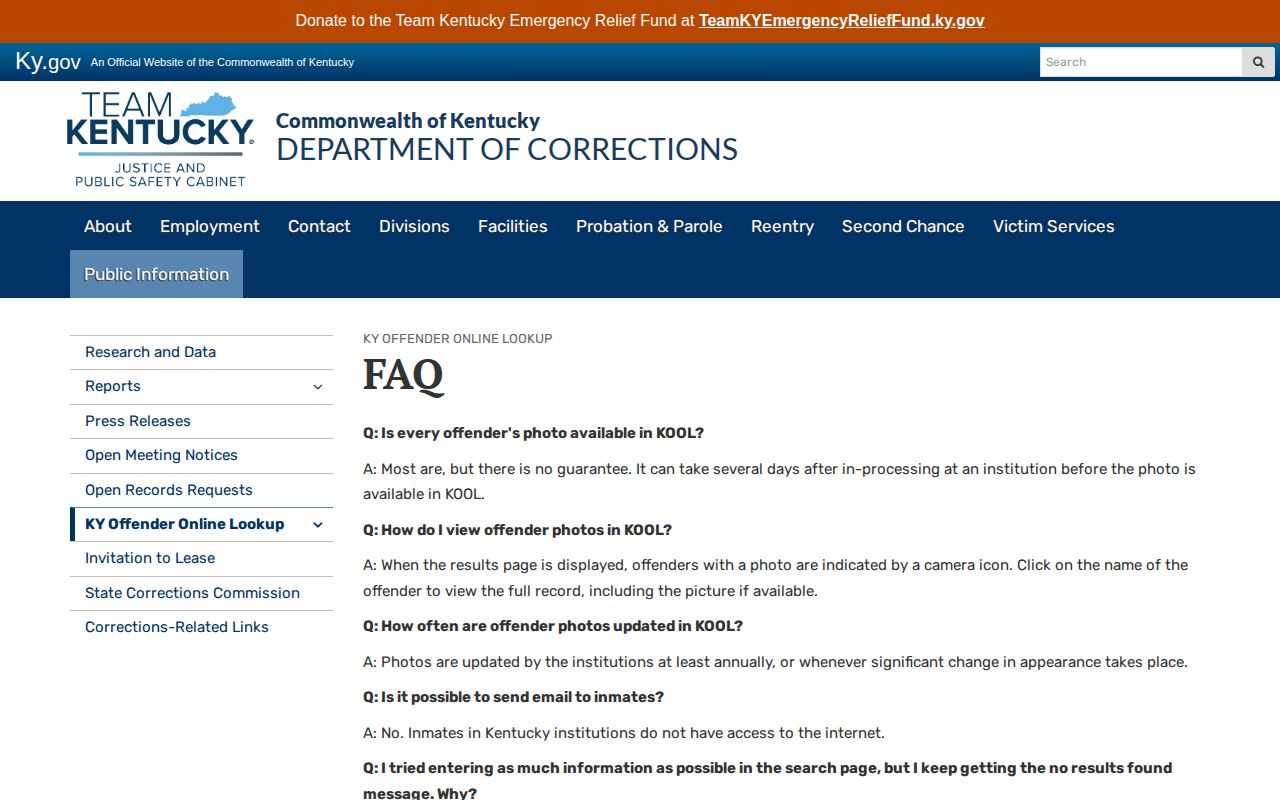
This source helps interpret why a state record may change or move out of the public search, but an agency record remains the best evidence for a past event.
Lee County Sentence Credits
KRS 197.045 supplies Kentucky’s main sentence-credit framework. It includes credit for prior confinement, good behavior, approved education and treatment, meritorious conduct, and exceptional service in covered cases. The statute allows up to ten days per month for good behavior and up to seven days per month for meritorious credit. Certain approved programs or credentials can yield set credits. Discipline can cause credits to be denied or forfeited.
Consecutive sentences are combined for expiration and credit calculations. Program eligibility and sex-offender treatment provisions can limit whether a credit applies. CPP 15.3 gives KDOC implementation detail for meritorious and extraordinary credit. For qualifying state felons held in a local jail, 501 KAR 2:060 connects statutory, education, treatment, and meritorious credits to KDOC rules.
The regulation’s official text shows why a state felon housed locally should not be treated like an ordinary pretrial detainee.
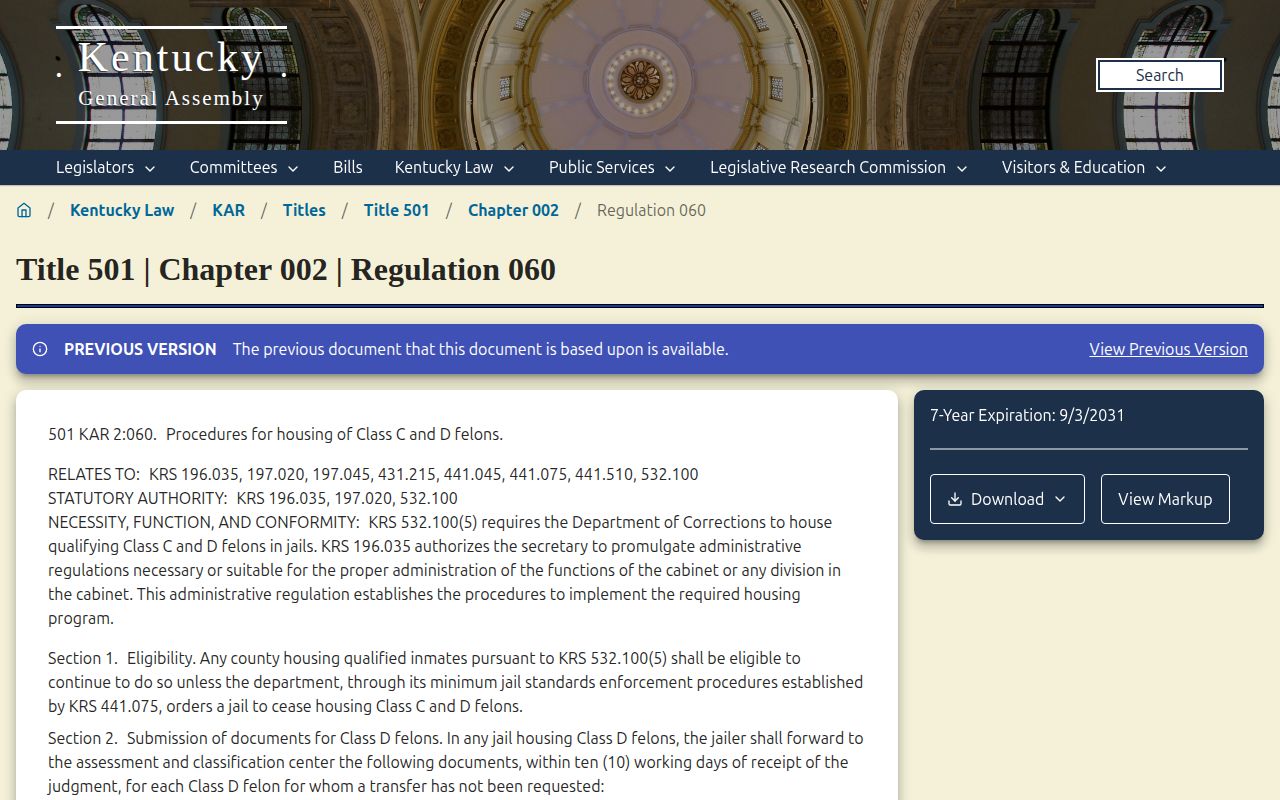
Its scope is specific. Merely being held at Three Forks does not place every detainee under the state-felon credit system.
Lee County Violent-Offender Rule
The current form of KRS 439.3401, effective July 15, 2026, requires a term-of-years violent offender as defined by that statute to serve at least 85 percent of the imposed sentence before probation, shock probation, parole, conditional discharge, or another early release. The current credit limit for that statutory class is also narrow. Life-sentence provisions have separate minimums.
The rule is not universal. It depends on the offense, the statutory definition, offense date, sentence, and governing version of the law. A charge label is not enough to calculate 85 percent. Older conduct may be controlled by prior text. Use the judgment, current statute, and KDOC calculation. Personalized arithmetic from a docket summary can omit custody credit, consecutive terms, or an amendment.
Note: Kentucky’s violent-offender statute changed days before this research, so current agency calculations should control case-specific dates.
Parole Dates Are Not Releases
501 KAR 1:030 provides a general first-review framework with many offense-date and sentence exceptions. For ordinary covered felony cases after the regulation’s stated date, its table includes different review points based on sentence length. That predicts review, not release. The Kentucky Parole Board can grant, deny, defer, or order a serve-out.
KRS 439.3406 creates mandatory reentry supervision for many qualifying prisoners before projected completion if discretionary parole was not granted. Current exclusions cover several sentence, security, and repeat-release groups. A person on this form of supervision is considered released on parole, and supervision runs to minimum expiration. Absconding can stop credit for qualifying time.
For the Lee Adjustment Center path, compare KOOL, the Board record, and the date-indexed KDOC Daily Releases archive. That archive documents state release events and releasing institutions. It is not a list of all people who left Three Forks.
Why Lee County Dates Change
Sentence forecasts respond to new facts and legal actions. A date can move in either direction. The reason should come from the updated record rather than inference.
| Change | Possible effect | Best confirmation |
|---|---|---|
| New program or conduct credit | May move minimum expiration earlier | KDOC computation record |
| Disciplinary forfeiture | May move the forecast later | Credit and discipline record |
| Prior-custody recalculation | Changes credited time | Judgment and KDOC calculation |
| New or amended judgment | Can alter term or sentence structure | Signed court order |
| Consecutive sentence | Aggregates terms and expiration | Sentence computation |
| Parole decision or revocation | Changes custody or supervision path | Board and KDOC record |
| Detainer or transfer | May prevent community release | Releasing and receiving agencies |
A detainer is another agency’s request to hold a person or provide notice before release. Transfer is movement between custodians, not community release. Preserve those source terms. If KOOL shows a future date, wait for a dated release or supervision record before calling it an actual event.
Confirm Lee County Actual Release
Use the source that owned the custody. For Lee Adjustment Center, check KOOL, KDOC Daily Releases, and the KDOC release record. For Three Forks, call the jail, check VINE, and obtain the release sheet or signed court order. If another agency received the person, continue in that system. The absence of a name from a roster establishes only that the current roster no longer shows the person.
Register through VINELink Inmate Search for custody-change notice, but confirm each alert. Kentucky’s official guidance warns that local and DOC entries can duplicate when a person crosses systems. VINE also documented a vendor event that produced false release notices. An alert is a prompt to call the agency, not conclusive proof.
Timing can also separate sources. A court order may authorize release before jail processing is complete. A Daily Releases PDF records a state event, while KOOL may display a later update. Save the retrieval date and use the newest agency record, but do not overwrite the terms in an older document. If one source says transferred and another shows community supervision, ask the releasing agency to explain the sequence.
A documentary request should ask for existing fields: projected or minimum expiration, calculation date, credits, actual release date, release type, releasing institution, receiving agency, and supervision begin date. That wording seeks records rather than asking staff to make a new calculation.
Public Record Search
Sponsored Results