
Lee County Parole and Probation
Parole and probation both permit a person to live in the community under rules, but they begin through different legal acts. The Kentucky Parole Board may grant parole after a state prisoner becomes eligible and receives review. Probation comes from a judge’s sentence. The Kentucky Department of Corrections Division of Probation and Parole administers community supervision for both groups.
Custody history is the key. Three Forks is a regional county jail, while Lee Adjustment Center is a state-contract prison operating within the KDOC system. A Three Forks departure could mean bond, time served, dismissal, transfer, or another court-authorized result. It does not by itself prove parole or probation. A Lee Adjustment Center departure can be parole, mandatory reentry supervision, sentence expiration, a court order, or transfer. Read the exact status in the owning record.
| Point | Parole | Probation |
|---|---|---|
| Who authorizes it | Kentucky Parole Board or a statutory supervision process | The sentencing court |
| When it begins | After release from a prison sentence | Under a court sentence, often without serving the full custodial term |
| Best proof | KOOL status, Board record, and KDOC supervision record | Signed judgment or later court order, plus the KDOC supervision record |
| How it ends | Final discharge, sentence completion, or another lawful termination | Court or agency record showing successful completion or termination |
- Parole
- Conditional release from a prison sentence with community supervision.
- Probation
- A court-ordered sentence allowing community supervision under stated terms.
- Discharge
- The legal end of custody or supervision, not merely a move out of one facility.
- Absconder
- A supervised person reported as having stopped contact or left supervision without approval.
Check Lee County Release Supervision
Verification starts with the person’s full name and, when known, a DOC or PID number. The Kentucky Online Offender Lookup, known as KOOL, supports searches by name, offender type, supervision status, and county of supervision. Its fields can separate an active community-supervision record from a prison record. KOOL can also show a supervising office, supervision begin date, and related sentence dates when those fields exist.
- Search KOOL by full name, then try the DOC or PID number to resolve similar names.
- Read offender type and supervision status exactly. Do not turn “inactive,” “released,” or “discharged” into a broader claim.
- Check the county of supervision and office. Lee County custody does not ensure Lee County supervision.
- For probation, compare the KOOL entry with the signed Lee Circuit or District Court judgment.
- For parole, check the Board schedule or decision record, then confirm the current status through KDOC.
- If the person is absent from KOOL, request the existing record from the agency that owned the custody or court order.
A name on a monthly eligibility list is not proof of parole. The Board publishes weekly hearing schedules and monthly calendars, and a hearing can occur before the eligibility date. The Board may grant release with terms, deny parole, defer a later review, or order a serve-out. No broad statewide decision search by person name was found. Check KOOL after the event and request the Board record when documentary proof is needed.
Lee County Supervision Contacts
Lee County is served through KDOC District 8 within Region 6. The research did not identify a separate public Lee County probation-office address, so the statewide agency page and the Region 6 contacts are the sound routing channels. A supervising officer remains the source for a named person’s reporting instructions. Reentry staff can help identify the correct program or custody layer, but they do not replace the official officer or record.
KDOC Probation and ParoleDistrict 8, Region 6
Agency and district information
Lee-serving reentry navigation
District 8 P&P coordinator Gregory Purvis: 859-274-3067
Lee Adjustment Center coordinator Kristy Hounshell: 606-464-2866
Powell/Lee county-jail coordinator Courtlyn King: 606-362-6348
The official KDOC Region 6 page is the source for these roles. Call the contact that matches the person’s path. A released Three Forks detainee with a local court case belongs first in the county-jail and court channel. A state prisoner leaving Lee Adjustment Center belongs in the KDOC institution and community-supervision channel.
The Kentucky supervision page shows the agency structure used for this work.
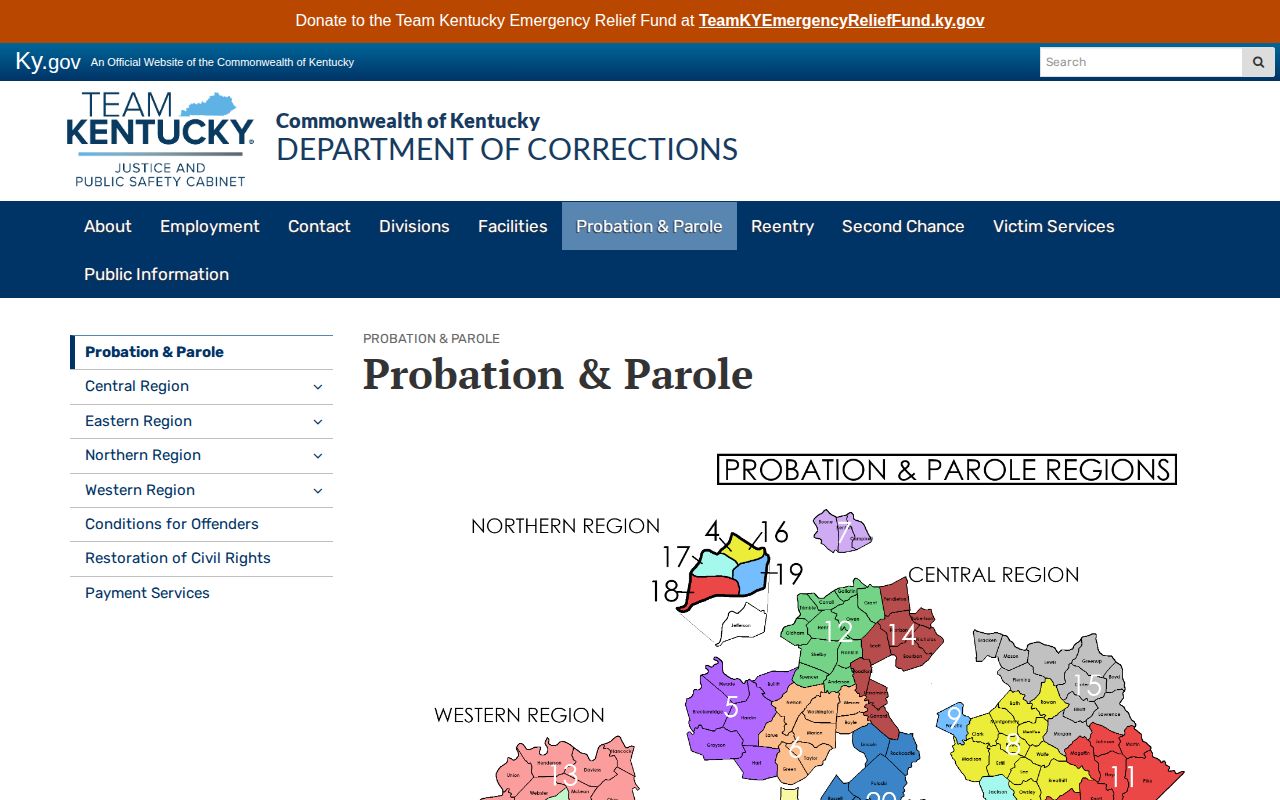
This official view helps confirm the correct state agency before a reader calls a Lee-serving reentry contact or asks for a supervision record.
Three Lee County Release Paths
Region 6 publishes separate contacts for community supervision, Lee Adjustment Center, and the Powell/Lee county-jail layer. That split is unusually useful. It reflects three different questions that can look alike in a name search. One concerns a person reporting to Probation and Parole. Another concerns a state prisoner preparing to leave Lee Adjustment Center. The third concerns someone leaving a county or regional jail who may need reentry help but may not be on parole at all.
Start with the releasing system. For Three Forks, call the jail at 606-464-2598, review VINE, and obtain the signed court record if needed. For Lee Adjustment Center, use KOOL, the KDOC Daily Releases archive, VINE, and the supervision entry. For a court-ordered probation sentence, ask the Lee Circuit Court Clerk for the signed judgment rather than relying on a calendar entry. The Lee County released-inmate search path explains how those sources fit together.
Reentry contacts provide program navigation. They do not confirm that a person is free of custody, has complied with supervision, or reached final discharge.
Lee County Supervision Status Changes
Conditions are the rules attached to release. They may address reporting, travel, treatment, fees, or other terms set by the court, Board, or supervising agency. The exact terms belong to the person’s order and supervision record. A general agency summary cannot answer a case-specific question. If the terms matter to a court or legal process, obtain the signed order or official KDOC record.
A violation allegation is not the same as a final revocation. Revocation is the formal act that ends community release and may return a person to custody. An absconder label means the agency reports lost contact or unauthorized departure. It should not be rewritten as a new conviction. A warrant or detainer can also change where a person appears. A detainer is another agency’s request to hold or notify before release.
Kentucky VINE may provide custody or status-change alerts, but it is not the full supervision file. Search both local and DOC records when a person moved from Three Forks into KDOC, because Kentucky warns that duplicate records can exist. Then confirm the alert with the jail, KDOC, Board, or court. The VINELink inmate search gives the registration and confirmation steps.
Confirm Lee County Final Discharge
Release from a building and discharge from a sentence are different events. Parole keeps part of a sentence active in the community. Mandatory reentry supervision, or MRS, places many qualifying prisoners on supervision before projected sentence completion. Under current KRS 439.3406, a person on MRS is considered released on parole, and qualifying absconding time is not credited. The current statute also contains exclusions, so status must come from the person’s record.
Final discharge is the later legal end of parole. KRS 439.354 and KRS 439.356 govern parts of that process and its legal effect. Useful proof includes a final-discharge document, an updated KOOL record, or the agency’s response to a focused record request. A past facility departure alone does not establish it.
For older or missing KOOL entries, contact KDOC Offender Information Services at P.O. Box 2400, Frankfort, KY 40602-2400. Ask for an existing parole, probation, supervision, release, or final-discharge record by name and DOC/PID number. This is more precise than asking the agency to interpret a whole case.
Note: Kentucky release statutes changed recently, so offense date and the version governing the sentence may matter.
Public Record Search
Sponsored Results